

Quick answer: the AQUASTRONG HEX100 is the best pool heat pump for cool climates. It is a full DC variable frequency inverter rated at 15.8 COP that both heats and cools, runs at 55 dB, and fires an automatic defrost cycle every 40 minutes so the coil keeps pulling heat out of damp air long after other units have iced up. It is also the most reviewed pool heat pump on this list, with 534 owner ratings behind it, which is the reason we trust the spec sheet and the street reality to match.
That last point matters more than usual here, because a pool heat pump in a cool climate is not really a comfort purchase. It is a running-cost purchase. The unit has to hold a set water temperature across twelve to twenty-four hours a day, and the number that decides your monthly bill is the coefficient of performance, not the BTU badge on the box. COP falls as outdoor temperature falls, which is exactly the direction the weather moves in the shoulder seasons when you actually want the water warm.
Most roundups treat the topic as a generic pool heat pump list and mention cold weather once. This one is built the other way around. We compared all 10 units below against the same cool-climate criteria: output and COP at low ambient, defrost behaviour, whether the unit modulates or simply cycles off, corrosion resistance for coastal and saltwater installs, and the electrical and plumbing work each one demands. If you want the seasonal-extension angle first, our heat pump pool heater season extension guide covers the habits that decide whether a unit keeps up.
Table of Contents
- Top 3 Pool Heat Pumps for Cool Climates in 2026
- Quick Comparison: 10 Pool Heat Pumps for Cool Climates
- 1. AQUASTRONG HEX100 – Best Overall for Cool Climates
- 2. Varpoolfaye 120,000 BTU Inverter – Best Value for Large Pools
- 3. WARMBLU 28,000 Gallon Inverter – Best for Large Cool-Climate Pools
- 4. FibroPool FH270 70,000 BTU – Best for Above-Ground Pools
- 5. FibroHeat FH255 55,000 BTU – Best for Smaller Pools
- 6. Hayward HeatPro 140,000 BTU – Best for Coastal and Saltwater Installs
- 7. MICOE 100,000 BTU Inverter – Best for Fast Heat-Up
- 8. Vidapool 75,000 BTU Inverter – Budget Pick
- 9. AQUASTRONG HEX035TOP – Best for Tight Installation Spaces
- 10. TURBRO B50V 50,000 BTU – Best for Fault Protection
- How Cold Is Too Cold: The Ambient Temperature Floor
- How to Size a Pool Heat Pump for a Cool Climate
- What COP Actually Means When the Air Gets Cold
- Heat Pump vs Gas Heater in a Cool Climate, and When to Skip a Heat Pump
- Defrost, Freeze Protection and Winterizing the Unit
- Frequently Asked Questions
- Conclusion: The Best Pool Heat Pumps for Cool Climates in 2026
Top 3 Pool Heat Pumps for Cool Climates in 2026
These three are the picks we would actually install in a four-season climate. The HEX100 wins on inverter efficiency and defrost reliability, the Varpoolfaye wins on capacity for large in-ground pools, and the Hayward HeatPro wins on brand serviceability and coastal materials.

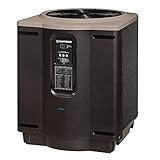
Hayward HeatPro 140K
- Titanium heat exchanger
- Ultra Gold fins
- UV-resistant panels
- 320 pounds
Quick Comparison: 10 Pool Heat Pumps for Cool Climates
All ten picks, ordered as they appear below. Output ratings are manufacturer figures measured in favourable air, so read them as a ceiling rather than a promise on a 45F morning.
| Product | Specifications | Action |
|---|---|---|
| AQUASTRONG HEX100 Inverter |
|
Check Latest Price |
 Varpoolfaye 120000 BTU Inverter Varpoolfaye 120000 BTU Inverter |
|
Check Latest Price |
 WARMBLU 28000 Gallon Inverter WARMBLU 28000 Gallon Inverter |
|
Check Latest Price |
 FibroPool FH270 70000 BTU FibroPool FH270 70000 BTU |
|
Check Latest Price |
 FibroHeat FH255 55000 BTU FibroHeat FH255 55000 BTU |
|
Check Latest Price |
| Hayward HeatPro 140000 BTU |
|
Check Latest Price |
 MICOE 100000 BTU Inverter MICOE 100000 BTU Inverter |
|
Check Latest Price |
 Vidapool 75000 BTU Inverter Vidapool 75000 BTU Inverter |
|
Check Latest Price |
 AQUASTRONG HEX035TOP Inverter AQUASTRONG HEX035TOP Inverter |
|
Check Latest Price |
 TURBRO B50V 50000 BTU TURBRO B50V 50000 BTU |
|
Check Latest Price |
1. AQUASTRONG HEX100 – Best Overall for Cool Climates
Swimming Pool Heater for Above Ground and Inground Pool 20’*43’*48″
15.8 COP DC inverter
Heats 47-104F and cools 47-83F
55 dB
Defrost every 40 min
3-year warranty
Pros
- Heats and cools in one unit
- 15.8 COP inverter efficiency
- 55 dB quiet operation
- Automatic defrost every 40 minutes
- App scheduling and energy tracking
Cons
- Capacity varies by pool size option
- Plumbing and electrical work required
We put the AQUASTRONG HEX100 at the top of this list because it does the one thing a cool-climate buyer cares about most: it keeps delivering heat after the outdoor air has already started to cool. The full DC variable frequency inverter is rated at 15.8 COP, and the dual-mode design heats from 47F to 104F and cools from 47F to 83F, so the same cabinet is useful in September and again in May.
It also carries the largest review base of any pool heat pump we compared here, at 534 owner ratings and a 4.3 average with 74 percent five-star. Automatic defrost runs every 40 minutes and completes in about five, which is the mechanism that lets the unit keep pulling heat from damp near-freezing air instead of icing itself shut. The app and on-unit panel handle scheduling and energy tracking, and 55 dB means it will not argue with a conversation on the deck.
Three connection options ship with it: 1.25 inch and 1.5 inch hose adapters, a 1.5 inch adapter conversion kit and a 1.5 inch PVC pipe converter. That flexibility matters when you are retrofitting around an existing equipment pad. Owners also report the cooling mode is genuinely usable rather than a spec-sheet extra, which is what turns the unit into a two-season machine instead of a spring-only one.
The honest limits are sizing and installation. Capacity changes with the pool-size option you pick, and matching it to your gallons is the most common reason a heat pump disappoints in its first season. A full install means plumbing plus a hardwired electrical circuit, which is not a casual weekend job.
Who the HEX100 suits in a cool climate
It suits an in-ground or large above-ground pool owner in a four-season climate who wants to swim through April and October without paying propane prices to do it. The 15.8 COP inverter and the 40-minute defrost interval are the two features that directly buy you shoulder-season days, and the app lets you schedule heating to off-peak hours so you are not paying peak rates for a slow heat-up.
Our season extension guide covers the cover-and-schedule habits that multiply what this unit can deliver for a few dollars a month in consumables.
Who should skip the HEX100
Skip it if you need heat on demand, because even a 15.8 COP inverter heats slower than a gas heater by design. It is also the wrong pick for a very small basin, where 116.8 pounds of hardware and careful capacity matching is more than the job requires. If you live somewhere with sustained sub-25F nights, read the section on when a heat pump is the wrong answer before you buy anything.
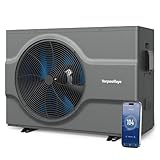
2. Varpoolfaye 120,000 BTU Inverter – Best Value for Large Pools
Varpoolfaye 120,000 Btu Inverter Pool Heat Pump for Inground Pools 220V
120000 BTU at COP 12.3
47 dB
Pools up to 33000 gallons
Fresh and saltwater
Saltwater compatible
Pros
- 120000 BTU at COP 12.3
- 47 dB quiet run
- Handles pools to 33000 gallons
- Freshwater and saltwater compatible
- WiFi app scheduling
Cons
- Third-party app has limited functions
- Some units needed a relay swap
- Slower heat-up than gas in deep cold
The Varpoolfaye 120,000 BTU inverter is the one we would look at first for a large in-ground pool in a cool climate. It is rated for pools up to 33,000 gallons, which covers nearly every residential in-ground build in the northern half of the country, and it is explicitly rated for both freshwater and saltwater, a detail that matters on the coast.
Owners report a realistic heat-up of roughly one to two degrees an hour with the pump circulating, and the 47 dB rating is genuinely quiet next to a filter pump. Cooling mode held pools in the low-to-mid 80s through summer heat for the owners we read about, so the same box earns its keep in both directions.
It ships with 1.5 inch connectors, a 118 inch power cord and a water-electric separation design, so the install is straightforward relative to the size of the machine. Support has a reputation for resolving issues quickly, and several owners who hit a leak or a freeze-related failure say it was sorted rather than argued.
Two things to weigh. The companion app is third-party and does less than the on-unit interface, so plan on the panel for daily control. And the honest cold-weather note from owners is that heat-up is slower than gas in genuinely cold conditions, which is a sizing conversation rather than a defect.
When to choose the Varpoolfaye over the HEX100
Choose it when your pool is large or you are adding a pool to an existing large property, because 33,000 gallons of capacity headroom is something the smaller units in this roundup do not offer. The 12.3 COP is lower than the HEX100 figure, but on a big body of water that extra output is worth more than the last two points of efficiency.
Saltwater and coastal installs are the other reason. If you are within spraying distance of the ocean, a unit explicitly rated for saltwater water saves you from betting on coil coating alone.
Where it falls short
It is the second-heaviest inverter unit we compared at 238 pounds, behind the 309 pound top-discharge model, so the pad and the handling plan are yours to solve. It is also a poor fit for anyone who wants a single unit to heat a small above-ground pool, where the extra output buys nothing but a larger electrical draw.
3. WARMBLU 28,000 Gallon Inverter – Best for Large Cool-Climate Pools
WARMBLU 28,000 Gallons Inverter Pool Heat Pump for Inground Pools 220V
Max COP 16.0
Pure titanium exchanger
Pools to 28000 gallons
Sub-50 dB
Draws about 1.3 kW
Pros
- Max COP 16.0 with titanium exchanger
- Handles pools up to 28000 gallons
- Draws about 1.3 kW while heating
- Sub-50 dB operation
- Heating and cooling in one unit
Cons
- Weighs about 200 pounds
- Built-in WiFi antenna is weak at range
- Flow rate needs a regulating valve
The WARMBLU is the efficiency standout in this group. It claims a maximum COP of 16.0 through its SpringBreath 1.0 system, and the part that actually impressed owners was the electricity: roughly 1.3 kW, or about six amps, while heating. For a pool owner on a time-of-use rate, a low steady draw is the whole game.
Capacity is up to 28,000 gallons, with a pure titanium heat exchanger that owners appreciate for treated water. Buyers report heat gains of roughly 20 degrees in a 24 hour stretch, and describe the running noise as quieter than a refrigerator, which checks out against the sub-50 dB claim.
The inverter control chip with its dynamic algorithm and the heating and cooling switch in one cabinet make this a genuinely two-season unit. Customer service, including outright swaps, came out well in the reviews, which is more than can be said for support on several budget-tier heaters.
The catch is plumbing discipline. Owners repeatedly note you need to regulate flow, either with a valve or by watching condensation draining out of the unit base, and the Smart Life WiFi setup is fiddly with a weak built-in antenna at range. The warranty is 12 months, which is thin for pool hardware that sits outdoors year round, so factor that into how long you plan to keep it.
Who gets the most out of the WARMBLU
It rewards owners on off-peak or time-of-use electricity plans, because a 1.3 kW draw is easy to schedule into cheap hours and easy to run overnight while nobody is swimming. Combined with a titanium exchanger and a 28,000 gallon rating, it also suits a large saltwater pool in a coastal area.
It is a good companion to a whole-home dehumidifying heat pump in a mixed-use household, since both pull efficiency from the same inverter principle and both suffer in the same deep-cold corner of the curve.
Who should pass on it
Pass if you want a long warranty behind the unit, because 12 months is thin for pool hardware that sits outdoors year round. At about 200 pounds it also needs two people to reposition, and anyone without patience for flow-rate balancing will find the setup frustrating.
4. FibroPool FH270 70,000 BTU – Best for Above-Ground Pools
FibroPool Swimming Pool Heat Pump – FH270 70,000 BTU – for Above Ground and Inground Pools and Spas – High Efficiency, All Electric Heater – No Natural Gas or Propane Needed
70000 BTU output
Titanium heat exchanger
Inground to 15000 gal
Enamel-coated steel cabinet
240 V circuit
Pros
- 70000 BTU with titanium exchanger
- Covers above-ground pools and spas
- Inground pools to 15000 gallons
- Enamel-coated steel cabinet
- Digital control panel
Cons
- Pool compatibility stated for mild climates
- Needs a 240V circuit and plumbing work
FibroPool’s FH270 covers an unusually broad set of pool types in this roundup: it is rated for above-ground pools up to a 27 foot round or an 18 by 33 foot oval, in-ground pools to 15,000 gallons, and spas. That breadth is the reason it is the pick for a large above-ground pool.
The 70,000 BTU output runs through a titanium heat exchanger driven by a high-pressure compressor, which owners credit with steady seasonal output rather than a strong start and a fade. The enamel-coated steel cabinet handles weather and corrosion, and the slim 38 by 15 by 26 inch footprint fits tight equipment pads that reject bulkier boxes.
At 157 pounds it is one of the lighter conventional units here, and the included 1.5 inch fittings plus a 240 V circuit requirement make it a straightforward job for an installer who has done pool work before. A digital control panel with an optional remote extension lets you monitor water temperature without walking over.
The one caution for cool-climate shoppers is on the label itself. The above-ground compatibility is stated for mild climates, which is a manufacturer’s way of saying the output figure assumes generous ambient air. Treat the 70,000 BTU as a mild-weather number and size up if your winters are serious.
When the FH270 is the right buy
It is the right buy when you have a large above-ground pool and want one appliance to cover heat in spring, cooling in summer, and a bit of shoulder-season top-up. The titanium exchanger and enamel cabinet also make it a sensible choice for anyone who does not want to think about coil corrosion.
It is equally a fit for a 15,000 gallon in-ground pool in a moderate climate, which is the situation where a 70,000 BTU single-stage unit matches the load without oversizing.
When to look elsewhere
Look elsewhere if your winters are genuinely cold and your pool is uncovered, because the mild-climate caveat is real. Also skip it if you need a heat-and-cool unit with genuine low-ambient cooling, since this one is heating-first with no cooling mode claimed.
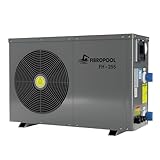
5. FibroHeat FH255 55,000 BTU – Best for Smaller Pools
FibroPool Pool Heat Pump – 55,000 BTU Electric – FH255 – Titanium
55000 BTU for pools to 10000 gallons
Titanium exchanger
Draws about 1.3 kW
Enamel-coated steel cabinet
Pros
- 55000 BTU for pools to 10000 gallons
- Uses about 1.3 kW while running
- Titanium exchanger suits saltwater
- Doubles as aux electric heater and chiller
- Quiet enough for a bedroom wall
Cons
- Dated control head
- No printed instructions and hard to reach support
- Minimal packaging can arrive dented
The FibroHeat FH255 is the veteran of this group, and its 133 reviews span owners in Arizona, Ohio, Florida and the Pacific Northwest. That spread is useful, because it shows the same 55,000 BTU titanium machine producing steady multi-degree daily gains in genuinely different weather rather than one climate’s ideal.
It covers pools up to 10,000 gallons, draws about 1.3 kW while running, and is quiet enough that owners place it near a bedroom window. It also switches between roles as a heat pump, an auxiliary electric heater and a chiller, which widens its usefulness across the year.
The titanium heat exchanger is specified for saltwater and chemically treated water, and the enamel-coated steel cabinet is built for outdoor duty. At 120 pounds it sits near the light end of the conventional chassis here, which makes it forgiving on a small pad or a retrofit.
The complaints are all about the interface and the box, not the heating. Owners describe a dated control head whose parameters cannot be adjusted while running and whose symbols are vague, no printed instructions with a hard-to-reach website phone line, and shipping protection so minimal that units sometimes arrive dented. Some also note soft-metal hardware screws that strip easily.
Who this older unit still serves
It serves the owner of a 10,000 gallon or smaller pool who wants a low-cost path to more swim days, and who is comfortable running an older control interface. The chiller and auxiliary electric modes give it a second and third use that newer inverter units charge you for.
Our attic fan roundup covers the other side of seasonal comfort for anyone whose real problem is a hot summer rather than a cold spring.
Where it falls behind
It falls behind for large pools, where 55,000 BTU is simply under-powered and will run for very long stretches to catch up. Buyers who value documentation and support will also be frustrated, since the phone line and the missing manual are the two most repeated complaints in the reviews.
6. Hayward HeatPro 140,000 BTU – Best for Coastal and Saltwater Installs
Hayward HeatPro Pool Water Heat Pump Heater for Inground Pools, 140,000 BTU
140000 BTU capacity
Titanium heat exchanger
Ultra Gold corrosion resistance
UV-resistant panels
320 pounds
Pros
- 140000 BTU for large in-ground pools
- Titanium exchanger resists salt and chemicals
- Ultra Gold corrosion-resistant technology
- UV-resistant body panels
- Long-established parts and service network
Cons
- Weighs 320 pounds
- Professional installation required
- Highest cost of the units compared
The Hayward HeatPro is the pick when your pool is large, your winters are real, and you live somewhere the air carries salt. Its Ultra Gold corrosion-resistant technology, UV-resistant body panels and titanium heat exchanger are aimed squarely at coastal installations, and the non-corrosive design is specified for exactly that environment.
At 140,000 BTU it is built for in-ground pools that get used regularly, and the heating comes from surrounding air rather than propane, natural gas or resistance electric elements. Hayward has more than eight decades of pool equipment behind it, which in practical terms means a control board or transformer is a normal service part rather than an internet mystery.
The trade-offs are physical and financial. It weighs 320 pounds, so the equipment pad, the access path and the crew all need planning, and professional installation is required rather than optional. It also sits at the top of the cost range in this comparison, which is why the 140,000 BTU pick does not carry our top badge despite the strongest name-brand support behind it.
Its 4.1 average across 114 ratings still holds a 70 percent five-star share, and the recurring buyer comments point to the 140,000 BTU capacity, the titanium construction and the service network as the reasons to pay up.
Who should buy the Hayward HeatPro
Buy it if you have a large in-ground pool, a coastal or marine exposure, and a preference for buying from a brand whose parts you can source in a decade. Reviewers repeatedly single out the established service network as the deciding factor over cheaper alternatives, and that is the same instinct we see in cold-region owner forums.
It is also the most sensible large-pool option here for saltwater, because corrosion resistance is specified rather than implied.
Who should skip it
Skip it on a tight pad, on a tight budget, or if you are installing it yourself, because 320 pounds and a required professional install are real barriers. If your pool is under about 15,000 gallons, this much capacity is wasted money.
7. MICOE 100,000 BTU Inverter – Best for Fast Heat-Up
MICOE 100,000 BTU Inverter Pool Heat Pump for 26,000 Gallon Pools
Up to 100000 BTU
Pools to 26000 gallons
Heats 46F-104F and cools 45F-82F
54 dB
2-year parts warranty
Pros
- Up to 100000 BTU for pools to 26000 gallons
- Heats 46F to 104F and cools 45F to 82F
- 54 dB variable-speed operation
- Automatic defrost in cooler conditions
- 2-year parts warranty with live chat support
Cons
- Wiring diagrams are confusing
- Flimsy plastic cover plate
- Some touchscreens reported unresponsive
The MICOE earns the fast heat-up slot because owners post the most concrete numbers we found anywhere in this roundup. Pools going from 58F to 82F in four days, and from 68F to 86F in 18 hours, both come from real reviewer reports rather than a spec sheet. The variable-speed inverter also runs at 54 dB, noticeably quieter than the older 120,000 BTU unit one owner replaced.
Capacity is up to 100,000 BTU for above-ground and in-ground pools up to 26,000 gallons, and the set ranges are unusually wide. Heating runs from 46F to 104F and cooling from 45F to 82F, with automatic defrost for cooler conditions, which is what keeps it working through the shoulder season.
Construction details are sensible for outdoors: a titanium heat exchanger for freshwater pools, an IPX4-rated UV-resistant ABS cabinet, and app plus panel control for scheduling. Support has a 2-year parts replacement warranty behind it with 24/7 live chat, and owners say the support team answers wiring questions by email within hours.
Installation is the weak point. Reviewers call the wiring diagrams confusing because the pump is shown routed through the 220V heater, and the plastic cover plate over the electrical connections is flimsy enough that they drilled a conduit for it. Some buyers also report unresponsive touchscreens and slow phone support, and eco mode runs more slowly than older single-stage machines.
Who benefits from the MICOE
It benefits owners who want the shortest realistic path from cold water to swimable water, and who have an installer who can sort out the wiring. The reverse into cooling held one owner’s pool in the mid 80s through summer heat, which makes it a genuine two-season machine.
It is also a strong pick if you want more warranty than the budget tier offers, since a 2-year parts replacement policy is uncommon among the units in this roundup.
Where it disappoints
It disappoints anyone who installs without help. If you are not going to have the connections right on the first attempt, the documentation will not get you there, and a drill hole for the cover plate is a good sign of what to expect. The 220 pound weight is another reason to bring a second person.
8. Vidapool 75,000 BTU Inverter – Budget Pick
Vidapool Swimming Pool Heater Electric Pool Heat Pump 21000 Gallons
Up to 75000 BTU
Pools to 21000 gallons
36 dB
ETL certified
Heating and cooling modes
Pros
- Up to 75000 BTU for pools to 21000 gallons
- 36 dB quiet operation
- ETL certified for electrical safety
- Inverter modulates instead of shutting off
- Three flexible connection options
Cons
- Only 47 reviews so long-term data is thin
- Lesser-known brand name
- Cooling mode wants a cover in extreme temperatures
The Vidapool is an inexpensive way into inverter pool heating, and on paper it punches above its class. Up to 75,000 BTU for pools up to 21,000 gallons, ETL certified for electrical safety, and the quietest specification in this roundup at 36 dB, which is genuinely quiet enough to sit beside a pool house door.
The behaviour owners like most is the inverter modulation. Instead of cutting out entirely when the set temperature is reached, it drops to low-power operation, which means steadier water temperature and fewer on-off cycles. It also switches between heating and cooling modes and offers app control for temperature and scheduling.
The same three connection options as other value-tier units appear here: 1.25 inch and 1.5 inch hose adapters, a 1.5 inch adapter conversion kit and a 1.5 inch PVC pipe converter, which covers most residential plumbing layouts. The brand claims up to 70 percent energy cost savings against natural gas, and the patented heat exchange technology with intelligent inverter control is what underpins that.
Be clear-eyed about the trade-offs. With 47 reviews there is not much long-term durability data yet, the manufacturer is a Jinan-based original equipment maker with little name recognition, and owners are advised to use a pool cover in extreme temperatures for stable operation. That last point is a real limit, not a disclaimer.
Who the Vidapool works for
It works for an owner of a mid-size pool who wants inverter behaviour and a low noise floor without stretching the budget. The modulating control is the reason it feels steadier than a single-stage unit of the same size, and 36 dB keeps it out of the conversation.
It is also a sensible second heater for a property with two pools or a pool and a spa, where a second low-draw unit is easier to justify than a single oversized one.
Who should choose something else
Choose something else if you want a long service history, a longer warranty, or a brand a local pool shop can service without an overseas parts shipment. At 205 pounds it is not an easy move either, and the cooling mode needs a cover behind it in truly cold weather.
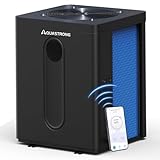
9. AQUASTRONG HEX035TOP – Best for Tight Installation Spaces
Swimming Pool Heat Pump for Above Ground Inground Pool 22’*30’*48″
110000 BTU
Pools up to 32000 gallons
Top discharge airflow
COP 12
37 dB operation
Pros
- 110000 BTU for pools to 32000 gallons
- Top-discharge airflow fits tight spaces
- Titanium exchanger works with saltwater
- 37 dB operation
- 12 COP full inverter
Cons
- Weighs 309 pounds
- Only 37 reviews
- Pool cover recommended for efficiency
The HEX035TOP is the highest rated unit in this roundup at 4.7, with 79 percent five-star ratings and not one one- or two-star review among the 37 posted. The reason is not subtle: it is the only unit here with a genuine top-discharge airflow design, which lets it install where a side-vent model physically will not fit.
Capacity is 110,000 BTU for pools up to 32,000 gallons, the second-largest gallon rating in this comparison, and the vertical air intake is matched to the top discharge so the whole box works in a narrow slot against a wall. Full inverter technology runs at 12 COP and drops to low-power operation at set temperature rather than cycling off.
The heat exchanger is an upgraded titanium unit rated for saltwater pools, and 37 dB is the second quietest figure here, just behind the Vidapool’s 36 dB. It includes 2 inch adapters plus a 2 inch to 1.5 inch conversion kit, so it adapts to more plumbing layouts than the 1.5 inch units in this roundup.
Two cautions. At 309 pounds it is the heaviest unit we compared, and that weight on a tight pad is worth thinking through before delivery day. With 37 reviews the long-term record is thin, and owners are advised to use a pool cover to get the most from it.
Why the top-discharge design changes the decision
It changes the decision for anyone with a constrained equipment pad, a side wall the box cannot breathe against, or a pool house where side venting would push hot air back into the enclosure. A side-discharge unit in that spot recirculates its own exhaust and loses efficiency, which quietly erodes the COP advantage you paid for.
It is also a strong saltwater option, since the titanium exchanger is specified for it, the 32,000 gallon ceiling sits just under the biggest rating here, and very few residential pools exceed either number.
Where it falls short
It falls short for anyone without two people and a solid pad, because 309 pounds is the heaviest thing in this roundup. It is also the pick with the thinnest evidence base at 37 reviews, so you are trusting the engineering rather than a long ownership history.
10. TURBRO B50V 50,000 BTU – Best for Fault Protection
TURBRO 50,000 BTU Inverter Pool Heater, Up to 15,000 Gallons, 220-240 V
Up to 75000 BTU
COP up to 16.2
Pools to 21100 gallons
Built-in sensors with fault shutdown
146.7 pounds
Pros
- Up to 75000 BTU at COP up to 16.2
- Handles pools to 21100 gallons
- Built-in sensors shut down on fault
- Panel and app with two timer periods
- Weighs 146.7 pounds
Cons
- Output drops as outdoor temps fall below 60F
- Needs a certified electrician
- Plumbing accessories not included
The TURBRO Beluga series is a compact inverter in this roundup at 146.7 pounds, and it carries the most elaborate monitoring package of the group. Built-in sensors track inlet and outlet water temperature, ambient temperature, current, voltage, pressure and flow, then shut the unit down on a fault and display an error code rather than limping along.
Output is up to 75,000 BTU at a COP up to 16.2, and the titanium heat exchanger resists both chemicals and saltwater. It suits pools up to 21,100 gallons, including a 28.3 foot round or a 20 by 40 foot oval, with control from a panel or an app that offers two programmable timer periods.
That weight is manageable where a 309 pound or 320 pound chassis is not, because a 146.7 pound unit is something one person can reposition on a bad weekend. The connection is hardwired 220-240V, and the package includes rubber blankets, drain connectors, a drain pipe and water pipe joints to get the plumbing started.
The manufacturer is candid about the limit that matters most for this article: it performs most efficiently at outdoor temperatures of 60F and above, and efficiency and output decline below that. It is also not recommended for inflatable pools, and it is not intended to turn a pool into a hot tub.
Who the TURBRO is built for
It is built for owners who want an honest, monitored unit and who can arrange a certified electrician for a hardwired connection. The sensor suite is genuinely useful in cold weather, because freeze damage and flow loss are the failure modes that ruin pool heaters, and this one shuts itself down instead of grinding on.
Two timer periods on the app or panel also make it easy to run heating entirely inside an off-peak electricity window, which is where the high COP pays off.
Who should look elsewhere
Look elsewhere if you need a hard heat-up guarantee below 60F, or if you want hoses, valves, filters, pumps and chlorinators included, because none of those come with it. The 34-review base is also the thinnest here, so treat the sensor list as a design promise rather than a proven record.
How Cold Is Too Cold: The Ambient Temperature Floor
A standard pool heat pump loses meaningful efficiency below 50F ambient and effectively stops heating below about 40F. That threshold is not a marketing line, it is physics: the unit is a refrigeration cycle that harvests heat from outside air, and when that air has little heat left in it, there is less to move.
This is the single most important correction to the way pool heat pumps are marketed. A spec sheet that says COP 15.8 is measured in favourable air, and the same unit at a 45F morning is not delivering a sixth of that. Always read a COP figure as a number plus a condition, and treat any unconditioned number as optimistic by default.
Practical consequence: if your average winter low sits between 40F and 55F, a heat pump is a shoulder-season machine that extends your season by four to eight weeks. If it sits between 25F and 40F, a heat pump still works but runs nearly around the clock, so the monthly bill rather than the purchase price becomes the number that matters. Below sustained 25F, plan on gas or a hybrid.
How to Size a Pool Heat Pump for a Cool Climate
Start with surface area, not gallons. A standard rule of thumb used across the pool trade gives 20 square feet of pool surface per 1,000 BTU of heating capacity, and a second formula multiplies surface area by temperature rise by 12. Both are estimates, and both assume an uncovered pool in decent weather.
In cool climates, treat them as a starting point and adjust in three steps. First, add roughly 25 to 30 percent for a pool without a cover. Second, if your target is the shoulder season rather than midsummer comfort, you can often step down one size because you are not fighting 20F water. Third, respect the run-time reality: a heat pump is sized to run 12 to 24 hours a day, so a too-small unit stretches runtime and raises your cost per degree.
This resolves the 95,000 versus 140,000 BTU argument that runs endlessly in pool owner forums. Neither number is correct on its own. A 95,000 BTU unit can hold a mid-size covered pool perfectly in shoulder season; a 140,000 BTU unit is the right call for a 20,000 gallon uncovered pool in a climate where you want usable water in late September. Oversizing inflates the purchase and shortens runtime without improving cost per degree, and undersizing stretches runtime and inflates the bill. Match the load to the pool, not to a brand leaderboard.
What COP Actually Means When the Air Gets Cold
COP, the coefficient of performance, is the number of units of heat a heat pump delivers for each unit of electricity it consumes. A pool heat pump at COP 5.0 delivers five times the energy it takes in, which is why it undercuts gas on running cost in almost any climate where it operates normally.
For pool math, work it out like this: COP equals BTU output multiplied by hours run, divided by kilowatt-hours consumed multiplied by 3,412. If a unit delivers 100,000 BTU for 10 hours, that is 1,000,000 BTU of heat, which takes about 146 kWh of electricity at COP 5.0. At COP 3.0, the same heat takes roughly 244 kWh. That gap is the entire argument for inverter compressors in cool weather.
Variable-speed and inverter changes are what protect that number. A fixed-speed unit switches on and off at set temperature, and every start-up cycle costs you efficiency while the refrigerant is out of balance. An inverter modulates instead, trimming to low-power operation, which is why the AQUASTRONG, WARMBLU, Vidapool and TURBRO units here hold temperature more steadily than the single-stage FibroPool and Hayward models. Schedule any of them inside off-peak hours and you convert a good COP into a noticeably cheaper month. Owners in cold regions who pair a heat pump with a solar cover routinely report a stable 6 degree lift through shoulder season, which is a realistic expectation to plan around.
Heat Pump vs Gas Heater in a Cool Climate, and When to Skip a Heat Pump
The honest answer in a cool climate is that a heat pump and a gas heater are good at opposite things. The heat pump wins decisively on running cost, winning by a wide margin once you measure cost per degree over a full season. The gas heater wins decisively on recovery speed, and it keeps working when the air is too cold for a heat pump to be efficient.
That reversal is the point. In a warm climate a gas heater is mostly a cost problem; in a cool climate the question becomes whether your shoulder-season heating load justifies a second appliance. If it does, a heat pump alone is the answer. If your shoulder season is six weeks long and your pool is huge, a gas heater for those six weeks and a heat pump for the spring and fall is a defensible hybrid.
On the brand-versus-brand questions that come up constantly, the useful frame is not which name is better but which one has parts near you. Hayward wins on serviceability and coastal materials, as the Ultra Gold and titanium construction in this roundup shows. Raypak and AquaCal are the established names in the premium inverter and heat-and-cool segments, a category represented here only at the value end. Pentair and Jandy are the names owner forums most often single out for surviving harsh environments, which is about durability reputation rather than a measured COP advantage. FibroPool and the value-tier brands win on entry cost and lose on documentation and support reach.
And here is the answer most roundups skip. If your region sits at sustained sub-25F for weeks, a pool heat pump on its own is the wrong answer, and no amount of BTU will change it. At those temperatures the unit runs constantly, pulls very little useful heat, and eventually risks the evaporator coil. In that situation, a gas heater or a properly sized hybrid is the honest recommendation. If you also run whole-home heating in the same climate, our whole-home heat pump guide covers the cold-climate caveats that apply to residential compressors.
Defrost, Freeze Protection and Winterizing the Unit
Defrost is the cycle that keeps a pool heat pump alive in cool air. The fan pulls outdoor air across the evaporator coil, and when that coil approaches freezing, water in the air freezes onto the fins and blocks heat transfer. A defrost cycle briefly reverses the refrigerant flow, heats the coil, sheds the ice and returns to heating mode. The AQUASTRONG HEX100 runs one every 40 minutes with about a five-minute completion, the MICOE describes automatic defrost for cooler conditions, and the rest rely on similar internal logic.
Defrost costs you time and a little electricity, which is part of why COP is a curve rather than a number. A unit spending time in defrost at 42F is doing less useful work per hour than the same unit at 65F, no matter what the brochure says.
The practical warnings for cold-region owners come straight from the reviews. Some Varpoolfaye owners report freeze-related failures that needed a relay swap, and owners of FibroPool units have reported that the water temperature was not maintained overnight, which is a classic sign that the coil iced up and the unit was cycling without defrosting. Keep the polyethylene coil screen clear, keep airflow unobstructed on all sides, and never cover the unit with a winter tarp while it is still energized.
For the months you are not swimming, the right move is a proper shutdown rather than leaving it plugged in. Follow the manufacturer’s winterization steps, isolate power at the breaker, and if your region has hard freezes, protect any exposed water lines. If humidity in a closed pool house is the issue rather than outside cold, our whole-home dehumidifying heat pump guide covers the same coil-icing physics in a different room.
Frequently Asked Questions
How cold is too cold for a pool heat pump?
A standard pool heat pump loses meaningful efficiency below 50F ambient and effectively stops heating below about 40F. Between those temperatures it still runs and still heats, but COP drops sharply and the unit runs many hours a day, so your electricity bill rises even though the purchase price is unchanged. Below sustained 25F, a heat pump alone is the wrong tool and gas or a hybrid setup is the better answer.
Will a pool heat pump work in winter?
It will, provided you understand what you are getting. Winter operation means a heat pump running 12 to 24 hours a day holding a set temperature, with automatic defrost cycles keeping the evaporator coil clear. It is not efficient deep into freezing weather, and extended sub-freezing conditions risk the coil. Most owners shut the unit down and winterize it between uses rather than leaving it energized all winter.
Is it better to oversize a pool heat pump?
Usually not. Oversizing inflates the purchase price and shortens run time without improving cost per degree, and a fixed-speed unit that cycles on and off loses efficiency with every start. Undersizing stretches run time and raises the bill. The better approach is to size to the actual load using about 20 square feet of pool surface per 1,000 BTU, add roughly 25 to 30 percent for an uncovered pool, and step up only if you need fast recovery.
What is the typical coefficient of performance (COP) of a heat pump?
A pool heat pump typically delivers between 4 and 7 units of heat per unit of electricity, and the premium inverter units in this roundup claim 12 to 16 COP at favourable ambient conditions. The important qualifier is temperature: COP falls as outdoor air cools, so treat any figure without a stated ambient condition as optimistic. In cool climates the honest comparison is COP at your average winter low, not COP at midday in spring.
What are the downsides of using a heat pump pool heater?
Heat pumps heat slowly, so they cannot deliver heat on demand the way a gas heater does. Their output and efficiency fall as outdoor temperature drops, and defrost cycles interrupt heating at the coldest times. Installation needs a dedicated 220V circuit and plumbing work. Running cost is low but the appliance is large, heavy and noisy in absolute terms. And for rentals or commercial pools, a slow heat-up makes holding a set temperature around 82F to 84F far more practical than full comfort temperature.
Conclusion: The Best Pool Heat Pumps for Cool Climates in 2026
After comparing all ten units on cool-climate criteria, the AQUASTRONG HEX100 is our pick for the best pool heat pumps for cool climates in 2026. Its 15.8 COP inverter, automatic defrost every 40 minutes, dual heating and cooling and the deepest owner review base of any unit here make it the safest bet when the air outside is the thing working against you.
Skip it and pick the Hayward HeatPro if you need coastal materials and a deep parts network, the Varpoolfaye if your pool runs past 26,000 gallons, or the FibroHeat FH255 if a small pool and a low purchase price matter more than a modern control panel. And if your winters sit at sustained sub-25F, do not buy any of them: go gas, or plan a hybrid.
1 thought on “10 Best Pool Heat Pumps for Cool Climates (October 2026)”